Ampere Electric Car For Sale . Ampere electric scooters sales cross 75,000 unit mark in the indian market. The juicebox 40 is a high power, fast and compact electric car charger with advanced wifi internet control and smart grid features. Vauxhall Ampera Review Autocar from www.autocar.co.uk Ampere electric, the electric mobility business of greaves cotton limited has set a sales benchmark in august 2021, with overall sales volumes of close to 5,000 units. The company has one of the largest ev dealer network. Ampere says the roadster will only cost $9,900 and will be launched next year.
Voltage Gated Sodium Channel Location. There are two very different types of sodium channels: Xu j(1), berret e(1), kim jh(2)(3).
Voltagegated sodium channels Introduction BPS/IUPHAR from www.guidetopharmacology.org
(1)the department of physiology, university of texas health science center, san antonio, texas; Enac are present in absorptive epithelia, such as the distal kidney tubule, alveolar. Open, inactive and closed.there are 2 gates in na + vgc (unlike k + vgc which only has 1).
The Na + Vgc Can Occupy 3 States:
There is the activation gate and inactivation gate. Their main role is to induce an action potential (ap). (1)the department of physiology, university of texas health science center, san antonio, texas;
When The Cell Membrane Is Depolarized By A Few Millivolts, Sodium Channels Activate And Inactivate Within Milliseconds.
Open, inactive and closed.there are 2 gates in na + vgc (unlike k + vgc which only has 1). While their location in vivo remains uncle. However, the extent of their movement and their displacement across the transmembrane.
They Described Sodium Selectivity, Voltage.
These channels are gated by changes in the membrane potential (b). There are two very different types of sodium channels: The opening and closing of the channels are triggered by changing ion concentration, and hence charge gradient, between the sides of the cell membrane.
Xu J(1), Berret E(1), Kim Jh(2)(3).
The sodium current that initiates the nerve action potential was discovered by hodgkin and huxley using the voltage clamp technique in their landmark series of papers in the journal of physiology in 1952. Voltage gated sodium channels (na + vgc) are found within the plasma membrane of nerve cell axons. Like other channels, vgscs activate, deactivate, and inactivate in response to changes in membrane potential.
Voltage Gated Sodium Channels (Na + Vgc) Are Found Within The Plasma Membrane Of Nerve Cell Axons.their Main Role Is To Induce An Action Potential (Ap).
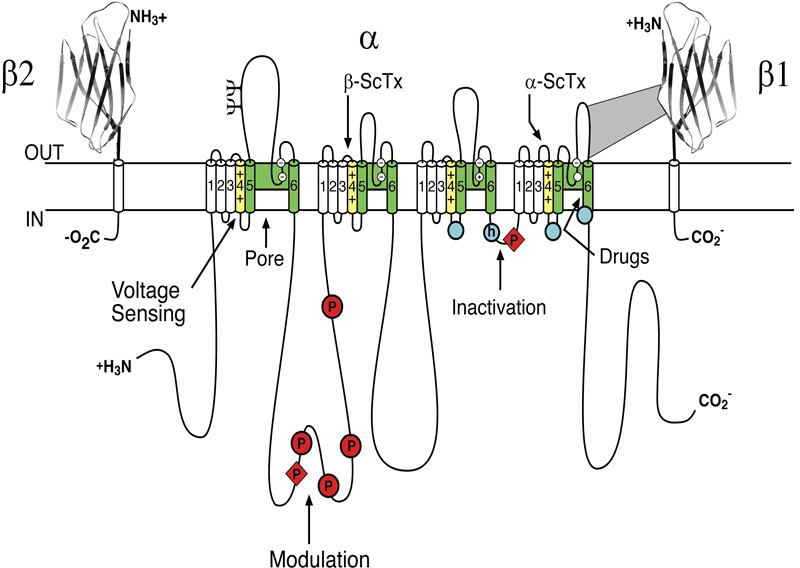
Here, the authors report that a conserved intracellular gate. Sodium channels have a modular architecture, with distinct regions for the pore and the gates. The fourth transmembrane segment (s4) in each domain acts as a voltage sensor.


Comments
Post a Comment