Ampere Electric Car For Sale . Ampere electric scooters sales cross 75,000 unit mark in the indian market. The juicebox 40 is a high power, fast and compact electric car charger with advanced wifi internet control and smart grid features. Vauxhall Ampera Review Autocar from www.autocar.co.uk Ampere electric, the electric mobility business of greaves cotton limited has set a sales benchmark in august 2021, with overall sales volumes of close to 5,000 units. The company has one of the largest ev dealer network. Ampere says the roadster will only cost $9,900 and will be launched next year.
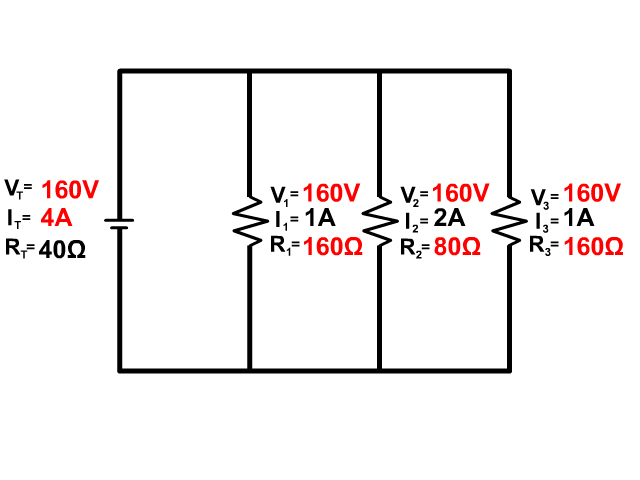
Does The Voltage Change In A Parallel Circuit. A parallel circuit has certain characteristics and basic rules: \ [ {v_s} = {v_1} = {v_2} = {v_3.
How To Solve Parallel Circuit Problems Wiring Diagram from www.ekocraft-appleleaf.com
Consequently, how does voltage work in a parallel circuit? The individual resistors placed in parallel will have a lower resistance than if they were placed in series. The total current is the sum of the currents flowing through each component, in a parallel circuit.
When Two Or More Batteries Are Placed In Parallel, The Voltage In The Circuit Is The Same As Each Individual Battery.
Voltage divider circuits are useful in providing different voltage levels from a common supply voltage. Current splits between the branches. What is the reading at:
Voltage Is The Same Across Each Component Of The Parallel Circuit.
Does series or parallel increase voltage? The voltage difference between $a$ and $b$ can be seen as the output voltage of the two batteries combined so that's why the voltage doesn't increase when you combine batteries in parallel. The dummy voltage sources are all set at 0 volts so as to have no impact on the operation of the circuit.
Remember The Voltage Increases When Batteries Are In Series, But With Batteries In Parallel This Is Not The Case.
The sum of the currents through each path is equal to the total current that flows from the source. It will stay the same kirchhoffs voltage law or kvl, states that “in any closed loop network, the total voltage around the loop is equal to the sum of all the voltage drops within the same loop” which is also equal to zero. One may also ask, does voltage increase in a.
A Parallel Circuit Has Certain Characteristics And Basic Rules:
The current along the branch with the smallest resistance will be larger than the branch with higher resistance. The total current in the circuit must remain constant (so that charge is not created/lost). In other words the algebraic sum of.
Using The Electricity As Water Analogy, Imagine The Source As A Water Spigot Outside Your House.
The different parallel current paths leading from one node to another are called branches, and a branch can consist of one or multiple resistors. Next, if we are connecting the two bulbs side by side or in parallel, the two bulbs will get the full voltage of the battery. Parallel circuit v1 1 0 r1 2 0 10k r2 3 0 2k r3 4 0 1k vr1 1 2 dc 0 vr2 1 3 dc 0 vr3 1 4 dc 0.dc v1 9 9 1.print dc v(2,0) v(3,0) v(4,0).print dc i(vr1) i(vr2) i(vr3).end


Comments
Post a Comment